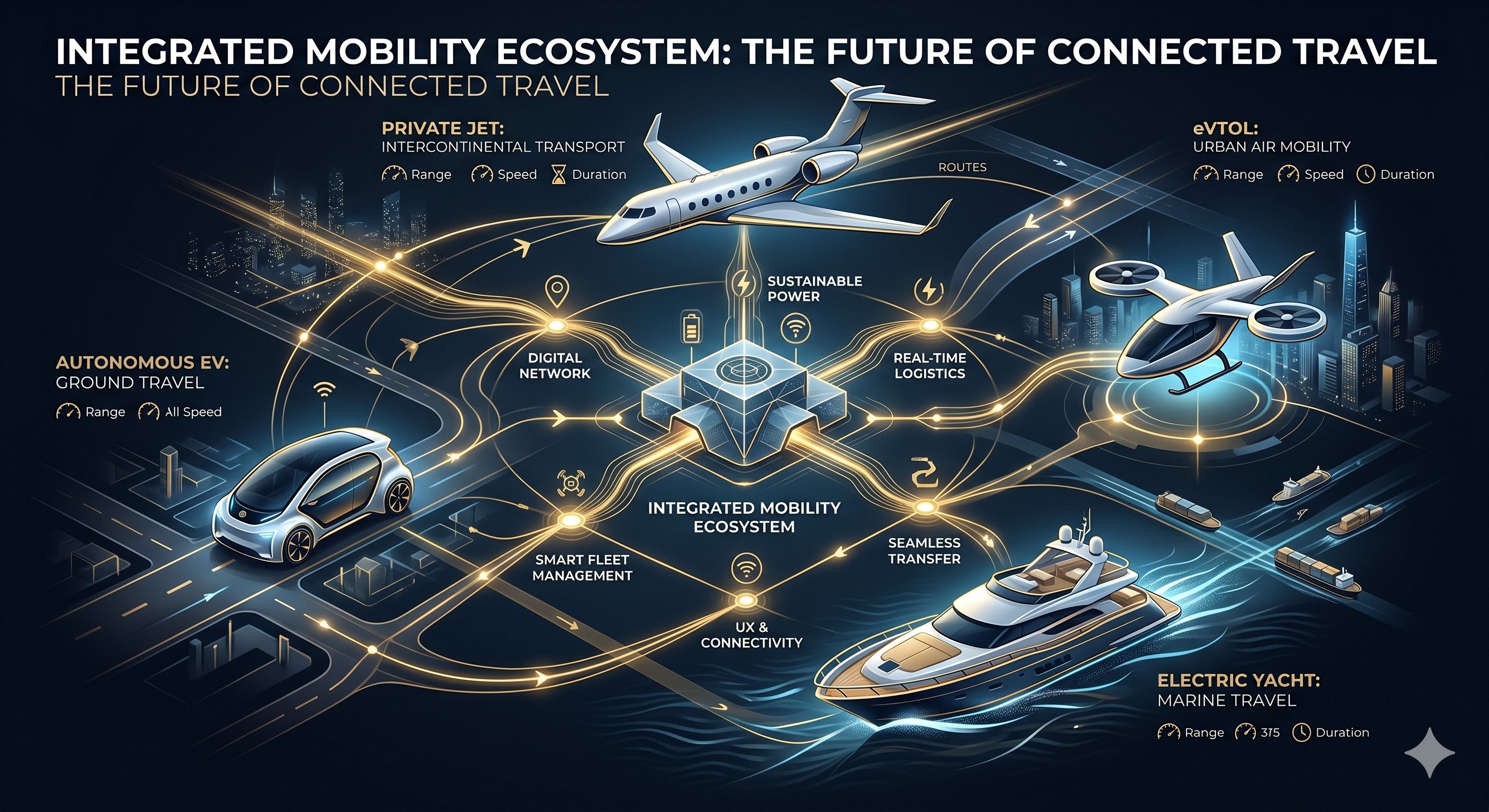
Each week we track the developments shaping private aviation, electric mobility, and the broader luxury transport ecosystem — the same markets that form the foundation of Global Lifestyle OS.
Compiled September 12, 2026 · Ownership Models · eVTOL & AAM · FBO · Market Fundamentals · Korea & Asia
Ownership & Access Models
Vista Brings Its Hospitality Concept to Asia for the First Time — Singapore Flight Hours Up 51% in the First Half
Vista will stage Vista House at the Formula 1 Singapore Grand Prix, its first activation in Asia and only its third anywhere after Augusta and Monaco, against reported first-half 2026 growth in Singapore of 51% in flight hours and 58% in flight traffic.
The format is an exclusive members' event hosted by Ferrari driver Charles Leclerc, followed by private viewing overlooking the circuit. Crystal Wong, president of Asia Pacific at Vista, described it as "a setting where Members can connect and celebrate." The operational point sits alongside the hospitality one: with the Bahrain Grand Prix relocated to Malaysia on October 2–4 and Singapore following immediately, Vista is coordinating back-to-back multi-destination travel for the same members across two Asian countries in a fortnight.
Why This Matters for GLO
- Vista is not selling aircraft access here — it is selling an occasion, and the aircraft is the means of getting to it. That is the correct instinct and it is the clearest signal yet that the competition in Asia has moved from hourly rates to what the membership actually opens
- But watch the boundary. Vista can coordinate two race weekends because both are the same kind of event, booked by the same desk, in the same quarter. The family attending Singapore is also moving a child between school terms, holding a medical appointment in a third country, and running a residence that has to be staffed on arrival — and none of that reaches the desk that arranged the paddock. A platform built around a calendar of events cannot become a platform built around a life; it has to be designed that way from the beginning
Source: Corporate Jet Investor, September 10, 2026
eVTOL & Advanced Air Mobility
Joby Opens Its Texas eIPP Campaign in Dallas–Fort Worth as an Autonomous Caravan Tours Ten States
Joby began a week-long air taxi campaign in the Dallas–Fort Worth region under the White House-backed eVTOL Integration Pilot Program with the Texas Department of Transportation, flying routes that connect Perot Field Fort Worth Alliance Airport, urban sites, and DFW International, with a 45,000-square-foot leased facility at Perot Field supporting North Texas operations.
The stated purpose is to generate operational data for the FAA while it writes the regulatory framework — the aircraft is flying to produce evidence, not revenue. Running in parallel, Joby's J208, a Cessna 208B Caravan fitted with autonomous flight technology, began a month-long tour across ten states having already logged more than 400 flights and over 800 automated flight hours, with stops at UPS Worldport in Louisville, Washington-area airspace, and North Carolina healthcare logistics programs.
Why This Matters for GLO
- Two aircraft, two different arguments, one company: the eVTOL is being flown to earn a rulebook, and the autonomous Caravan is being flown to prove the software on an airframe that is already certified. The second is the faster path to something a member can actually use, and it will arrive years before the first
- Korea's UAM work has an equivalent decision in front of it. Demonstration flights of a new airframe are a long road; autonomy layered onto aircraft already flying is a short one — and the operator who can offer both, coordinated with everything on the ground at either end, is the one a family will stay with
Source: eVTOL Insights, September 11, 2026
Archer and BETA Will Build a Shared Charging Network in Texas — Up to 250 Sites Over a Decade, Open to All Manufacturers
Archer Aviation and BETA Technologies, working through America's Consortium for Electric Skyways with Macquarie Capital and the Texas Department of Transportation, will build interoperable electric aircraft charging infrastructure across Texas, targeting as many as 250 air taxi sites at major US airports and metropolitan areas over the next decade.
The design decision is the story. This is explicitly a shared network usable by aircraft from multiple manufacturers and operators rather than proprietary infrastructure, sited at airports, FBOs, and other points of interest identified jointly with TxDOT. Planned regional flights link Dallas–Fort Worth, Austin, San Antonio, and Houston, with further routes connecting those metropolitan areas to rural communities.
Why This Matters for GLO
- Two direct competitors agreeing that the charging layer must be neutral is the most important structural news in this sector for months. It means the ground infrastructure will not be captured by one airframe manufacturer — and that the value in advanced air mobility will sit with whoever coordinates access across it, not with whoever builds the aircraft
- Note where they are putting the chargers: airports and FBOs. The FBO is becoming the charging point, the vertiport, and the arrival hall at once, which is precisely the convergence our own FBO model was designed around rather than retrofitted for
Source: eVTOL Insights, September 10, 2026
FBO Infrastructure
Incheon Opens the Tender — 140,000 Square Meters, Two Hangars, 24 Aircraft Stands, Terminal Targeted for 2028
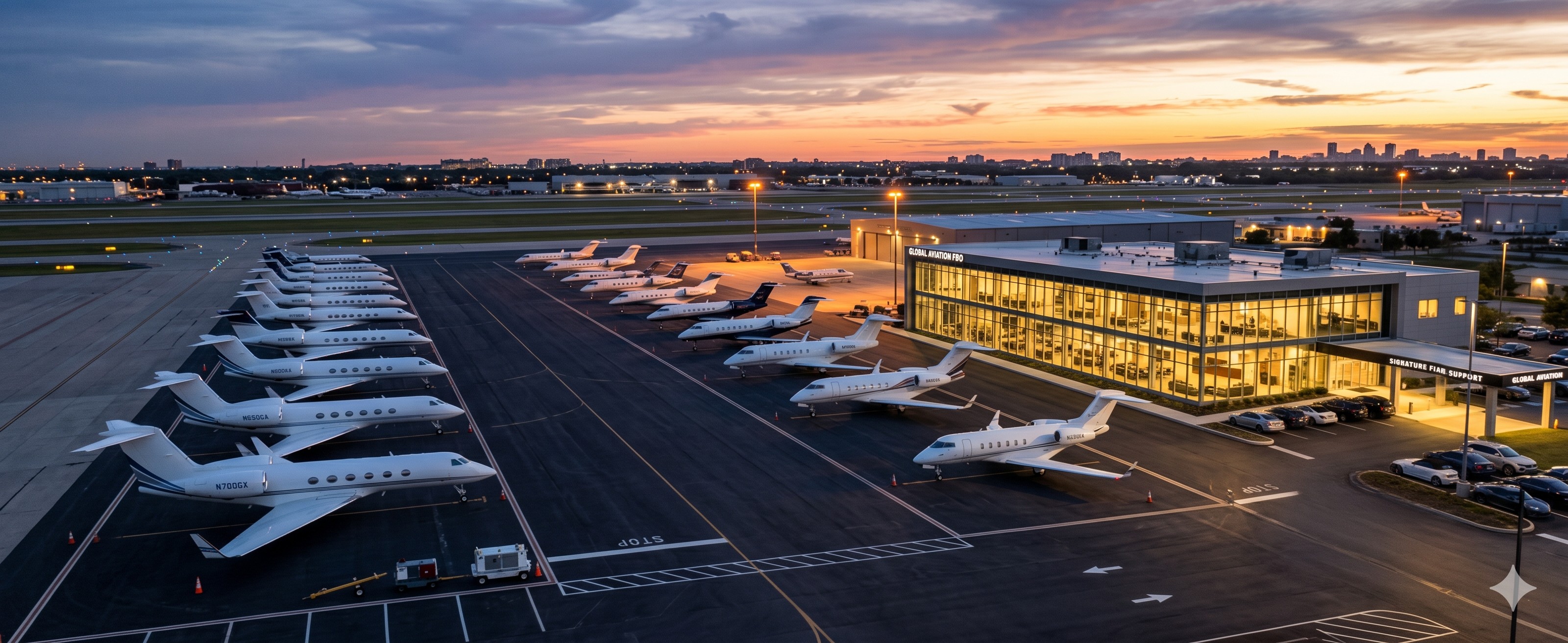
Incheon International Airport Corporation is launching this month the tender for a private developer to build its business aviation complex: 140,000 square meters comprising a dedicated private jet terminal, two hangars, and parking for 24 aircraft, with the terminal targeted to open in 2028.
The financing structure is the part that deserves attention. IIAC prepares the site and the apron and civil infrastructure; the selected private developer finances and constructs the terminal and the hangars in full. The complex will offer fueling, parking, and maintenance for charter and private aircraft, and the plan integrates it with urban air mobility infrastructure as part of a wider mobility hub. IIAC's case rests on business aviation growing roughly 12.3% a year through 2032, and on the observation that Incheon remains the only major global airport without a dedicated business aviation complex.
Source: Airport Information, September 8, 2026
Flexjet Opens Europe's First Operator-Owned Luxury Terminal at Farnborough — $34 Million
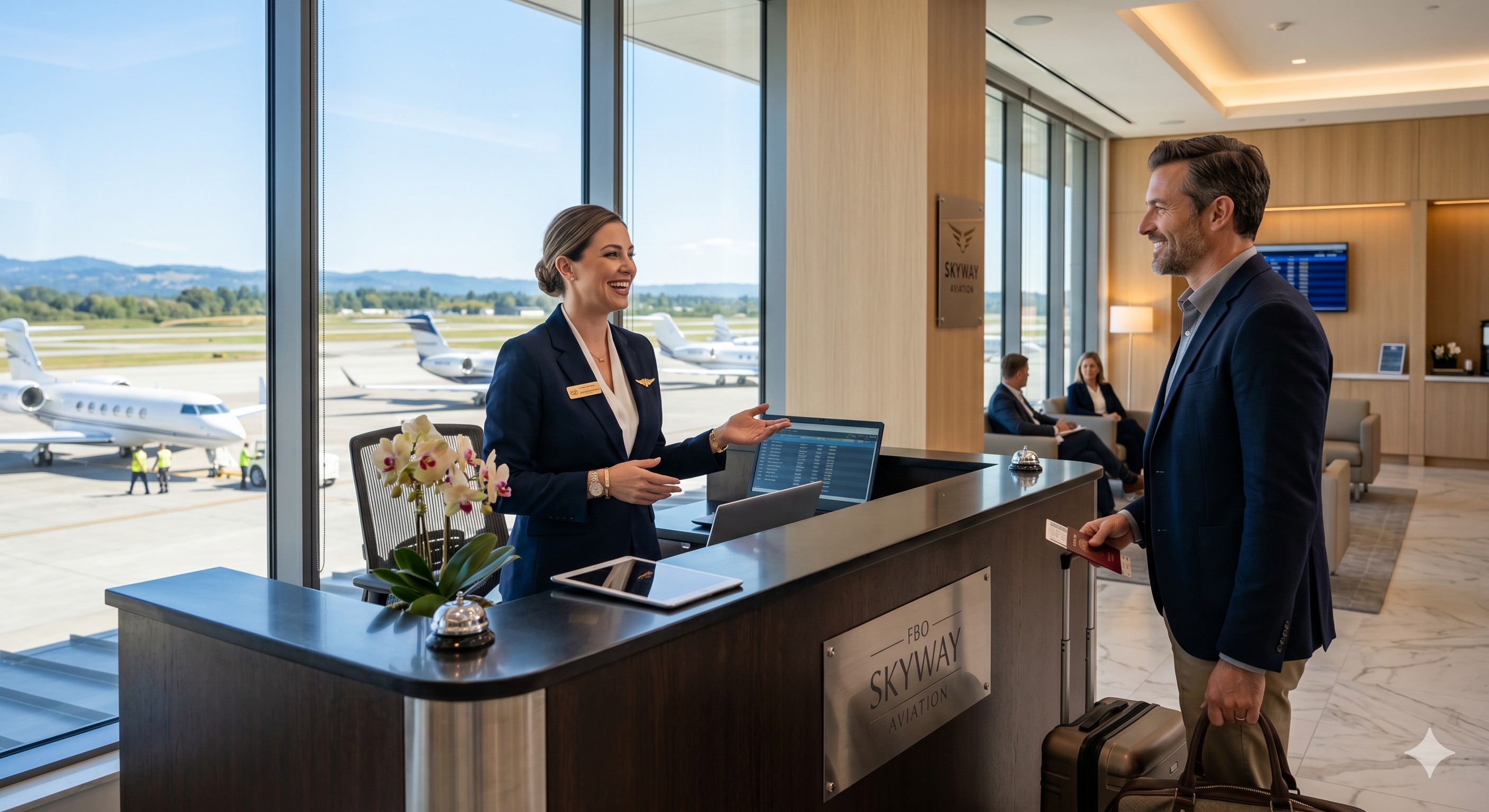
Flexjet invested $34 million over two years in a 2,098-square-meter terminal and a 3,530-square-meter MRO hangar at Farnborough — its tenth terminal open or in development globally and the first outside the United States, where the other nine sit.
Inside are a full-size Gulfstream G700 fuselage recreated as a lounge, an Owners Bar and Lounge overlooking the airfield, private meeting rooms, dedicated security and immigration screening, a tactical control center, and an expanded Red Label Academy training facility; 138 solar panels generate roughly 37,848 kWh a year and a syphonic system recycles rainwater. Flexjet operates more than 350 jets and helicopters with close to 300 cabin servers and over 1,500 maintenance staff across 15 locations. Chairman Kenn Ricci called it "one of the most significant branded luxury environments in private aviation."
Source: Flexjet via GlobeNewswire, September 10, 2026
Global Lifestyle OS · Our Differentiated Advantage
These two items landed in the same week and should be read together, because the second describes the standard against which the first will be judged. Flexjet did not lease space in someone else's terminal at Farnborough. It built its own, it put its European headquarters and its crew training academy inside it, and it filled the rest with the parts of the experience an operator cannot outsource — the lounge, the screening, the control center. That is what a modern premium terminal now looks like, and any bid at Incheon that proposes less will be measured against it by the same clients.
Look closely at how Incheon has structured the tender, because it defines who can win it. The corporation supplies the land and the apron; the private developer finances and builds the terminal and the hangars. This is not a concession to operate a facility someone else has built — it is an invitation to design one. Whoever takes it will decide what the building contains for the next several decades, on 140,000 square meters, with UAM integration written into the brief and a 2028 opening. A tender framed that way rewards the bidder who arrives with a complete operating model rather than a construction budget.
That model is documented and it predates the tender. The Corporate-Customised FBO Operating Model — the world's first — replaces the shared-terminal premise with dedicated corporate suites carrying an eight-layer service stack: board-level hospitality, a 24-hour resident physician, AI-integrated education from nursery through Grade 12, eVTOL and autonomous EV infrastructure, companion logistics, and suite-based security. It targets more than 60% non-aviation revenue, which is the mechanism by which it removes the structural deficit that leaves over half the world's regional-airport FBOs unprofitable — without a single additional commercial flight. Sixteen chapters, applied in detail to Korea's airports and to Korea's specific regulatory asymmetry in semi-private aviation. Flexjet has shown the market what a terminal should feel like. The brief sets out what it should earn, and why the two questions have the same answer.
Private Jet Market Fundamentals
The Global 8000 Wins London City Approval — Singapore to Downtown London, Nonstop
The UK Civil Aviation Authority approved Bombardier's Global 8000 for London City Airport, opening nonstop service into central London from Singapore, Los Angeles, Honolulu, and Buenos Aires — and saving passengers up to 60 to 90 minutes of ground transfer against Farnborough or Luton.
London City demands a steep noise-abatement approach onto a short runway, which most ultra-long-range aircraft cannot meet. Stephen McCullough, executive vice president of engineering and product development, credited the wing's leading-edge slats and braking systems for the field performance. The aircraft cruises at up to Mach 0.95 with 8,000 nautical miles of range and a 2,691-foot cabin altitude, the lowest in production; it entered service in December 2025 and is certified by Transport Canada, the FAA, and EASA. Bombardier says it can reach roughly 30% more airports than its nearest competitor.
Why This Matters for GLO
- Singapore to the City of London without a stop, and without an hour in a car at the end of it, changes the arithmetic of a same-day meeting in Europe for an Asian principal — and it is the kind of gain that only shows up when the aircraft, the airport approval, and the ground arrangement are considered as one problem rather than three
- It also raises the bar at the other end. An arrival engineered to save ninety minutes is wasted if the vehicle, the residence, and the schedule on the ground are not already synchronized to it — which is the entire argument for holding those layers on one platform rather than assembling them per trip
Source: Bombardier via GlobeNewswire, September 10, 2026
Korea & Asia
India Has 229 Billionaires and Fewer Than 200 Business Jets — the Gap Is Tax, Not Wealth
India's registered business jet fleet numbers fewer than 200 aircraft against 229 billionaires and 11,865 individuals holding more than $30 million in assets. A commercial non-scheduled operator pays 2.5% customs duty, a 10% social welfare surcharge, and 5% GST; the same aircraft in private use pays 3%, 10%, and 31% GST — 28% plus a 3% compensation cess.
A 5% versus 31% gap does not reduce demand, it reroutes it: ownership is structured through operating companies rather than held directly. The broader fixed-wing fleet reached about 315 jets and turboprops as of April 2026 alongside 274 helicopters, on a market worth $692.3 million in 2025 and forecast to $1.2 billion by 2035, a 6.18% compound rate. Infrastructure compounds the constraint — FBOs cluster in just four cities, Delhi, Mumbai, Nagpur, and Kochi. More than 80% of imports are pre-owned, largely because a used aircraft completes in two to three months against extended new delivery timelines. Light jets hold 44.8% of the market while large jets grow fastest at 7.5% a year.
Why This Matters for GLO
- This is the clearest evidence available that Asian private aviation is constrained by policy and infrastructure rather than by wealth. The money is present in quantity; what is missing is a structure that lets it be spent without penalty — and structuring is advisory work, not brokerage
- The same shape appears across the region in different proportions: a tax code that punishes direct ownership, a handful of cities with usable ground facilities, and a buyer who resolves it by buying pre-owned through an operating company. A family office can solve that once, with difficulty. A platform that has solved it repeatedly across jurisdictions solves it as a matter of course, which is the difference between a transaction and a relationship
Source: Global Air, September 10, 2026
Temasek and BlackRock Put $1 Billion Into Indian Airport Cities at an $18 Billion Valuation
Adani Airport Holdings signed binding agreements to raise approximately $1 billion in equity from Alpha Wave Global, Premji Invest, Temasek, and BlackRock-managed funds at a roughly $18 billion pre-money valuation, for a combined stake of about 5.54% across three tranches completing by July 2027.
The use of proceeds is where this becomes an aviation story rather than a financing one. Alongside airport expansion, the capital funds integrated "Adani Airport City" ecosystems — roughly 22 million square feet of mixed-use development in the first phase — and the scaling of non-aeronautical businesses including ground handling, against a target of some 200 million passengers a year. Jeet Adani, non-executive director, called it "an important milestone in building out the Adani Airports platform"; chief executive Arun Bansal said the aim is to "scale it into the world's largest airports platform."
Why This Matters for GLO
- Sovereign and institutional capital of this quality does not enter an airport at an $18 billion valuation for landing fees. It enters for the 22 million square feet beside the runway — the proposition that an airport is a property, services, and hospitality business that happens to have aircraft attached. That is our thesis, being executed at national scale in the next market over
- Read it against the Incheon tender in the same week and the direction is unmistakable: the value at an airport is migrating from aviation to everything adjacent to aviation. Incheon is inviting a private developer to build that adjacency on 140,000 square meters; Adani has raised a billion dollars to build it across a country. Both are asking the same question, and the answer at Incheon has a 2028 deadline attached to it
Source: Asian Aviation, September 10, 2026